Anphase case studyAI agent orchestration
Murongi
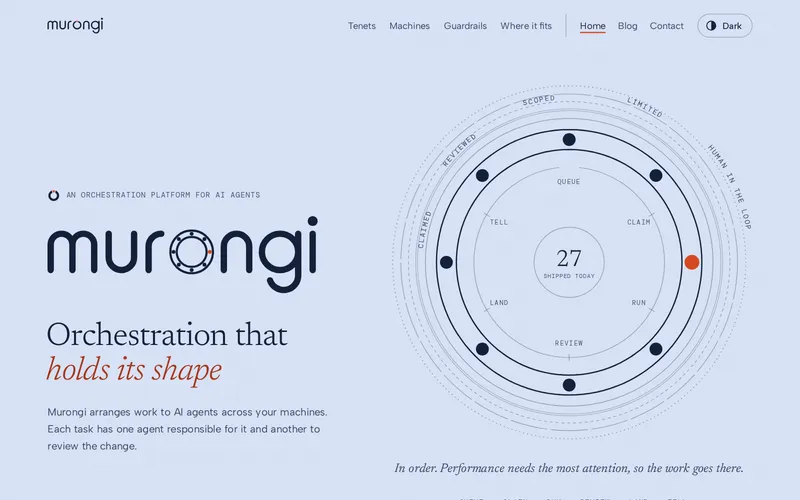
Murongi arranges work for AI agents across your machines, with one agent responsible for each task and a second to review the change.
The problem
Running several AI coding agents at once tends to drift into chaos. Two agents pick up the same task, changes land without anyone checking them and spending or publishing can happen without a person noticing.
The cost is rarely dramatic. It is idle time and duplicated effort spread across several machines, with the person who started the work as the only link between them, so the work stops whenever that person steps away.
Who it is for
Murongi is for a person or a small team with a few machines who want AI agents to take on work in parallel while they keep control of the steps that matter.
The approach
Murongi runs every task through the same loop: it waits in a queue, one agent claims it, runs it in its own copy of the code and hands it to a second agent for review. Reviewed changes join the main line, and a short note says what happened.
One project can be in focus while Murongi keeps the others healthy. Each project has an agent responsible for its upkeep, a written plan and a budget. The same work shows on every screen, so a run can start from a phone and wait for approval on a desktop.
Why it was built
Murongi started as a fix for its maker's own working day. With agents on a desktop, a laptop and a small computer in the corner, he would start work in the morning, step away for a few hours and come back to find one agent finished and waiting for its next task, another stopped on a question that needed ten seconds of his time and a third repeating a fix the first had already made.
A list in a text file lasted about a day, and so did assigning machines by hand. What was missing was one place where work waits in order and whichever machine is free picks up the next thing. Two things stood out once it existed: most of the value came from the plain parts, the queue and the claim, and the second agent's review caught more small mistakes than expected.
Exhibit
One morning, before and after
The tasks are typical of what gets handed out. The last column is how Murongi handles the same situations.
| Machine | Left doing | Found on return | With Murongi |
|---|---|---|---|
| Desktop | A release build | Finished, and waiting to be told what came next | It claims the next task in the queue |
| Laptop | A test pass | Stopped on a question that needed ten seconds | The question reaches a phone with the context written out |
| Small computer | A fix for a slow page | The same fix the desktop had already made | The claim shows the fix is taken, so it picks other work |
Guardrails that route work
A guard that only halts work turns the person into the one who has to restart it. So Murongi's five guardrails, drawn as rings from the narrowest inside to the widest outside, mostly decide where work goes next. Most checks send the work somewhere useful; requests outside the rules wait for approval, and the stop switch pauses new work.
Claimed keeps moving
One agent claims each task, and the claim is visible to the others.
When it trips Another agent already holds the task. Then The second agent picks a different task.
Reviewed keeps moving
A second agent checks every change before it lands.
When it trips The review finds a problem. Then Back to the first agent, with the findings attached.
Scoped can wait
Each agent gets only the access its task needs.
When it trips A task needs more than it was given. Then It asks, and anything outside the rules waits for a person.
Limited can wait
A run that goes past its budget stops, and one switch halts new work everywhere.
When it trips A run uses far more than a job of its kind needs, or the stop switch is on. Then An overrun goes back to the queue with a note on how far it got; the switch pauses new work until it is off.
Human in the loop can wait
Spending beyond a budget, publishing and deleting wait for a person.
When it trips A step spends beyond its budget, publishes or deletes. Then That task waits for an answer; the rest of the queue carries on.
These rules reduce the number of mistakes that reach the code. They do not remove the need for a person to read what lands.
Measuring before trusting
Murongi counts every run, including the ones that fail and the ones that are stopped, with the task it belonged to, where it ran, how much of the plan it used and how it ended. Counting only successes gave a flattering picture. Counting everything shows which tasks were expensive because they were hard and which were expensive because they looped, and those need different answers.
A usage meter feeds the Limited guardrail. When a plan runs low, new work can move to a plan with room or the queue can wait for the window to reset. In the maker's own set-up the meter is Monizard and the machines pass messages and hand-offs through svc.nz, both built at Anphase.
Where it stands
Murongi is in development. It runs every day across Anphase's own repositories and changes whenever something about it gets in the way. Its site walks through the loop with example numbers and keeps a short blog about building it.
Exhibit
Try it
Run a task through the loop
Every task in Murongi takes the same six steps, and the guardrails decide where work goes when it cannot carry on. Step through an example day, or press play. The tasks, machines and agents are examples.
- 01 Queue Work waits in order.
- 02 Claim One agent takes it.
- 03 Run In its own copy of the code.
- 04 Review A second agent checks it.
- 05 Land It joins the main line.
- 06 Tell A short note goes out.
Current task · Queue
Fix the failing sign-in test
- changes landed
- 0
- reviews by a second agent
- 0
- sent back with findings
- 0
- runs stopped by a guard
- 0
- waited for a person
- 0
Key features
One owner per task
A claimed task shows who is working on it, so no two agents start the same fix.
A second agent reviews
Every change is checked before it lands, and a failed review goes back with its findings.
Scoped and limited
Agents get only the access and budget a task needs, and an over-budget run returns to the queue with a note.
A person in the loop
Spending beyond a budget, publishing and deleting wait for your approval.
One switch
A single stop switch pauses new work on every machine.
Any device
Start work from a phone, watch it on a laptop and approve it from a desktop.
Status and platforms
- Status
- In development
- Platforms
- Phone, Laptop, Desktop
- Website
- murongi.com